
Vincent van Gogh's 'The Starry Night' is more than just a mesmerizing visual; it’s a profound exploration of the artist's psyche. Painted during a tumultuous time in his life, this iconic work captures a blend of beauty and chaos that resonates on multiple levels.
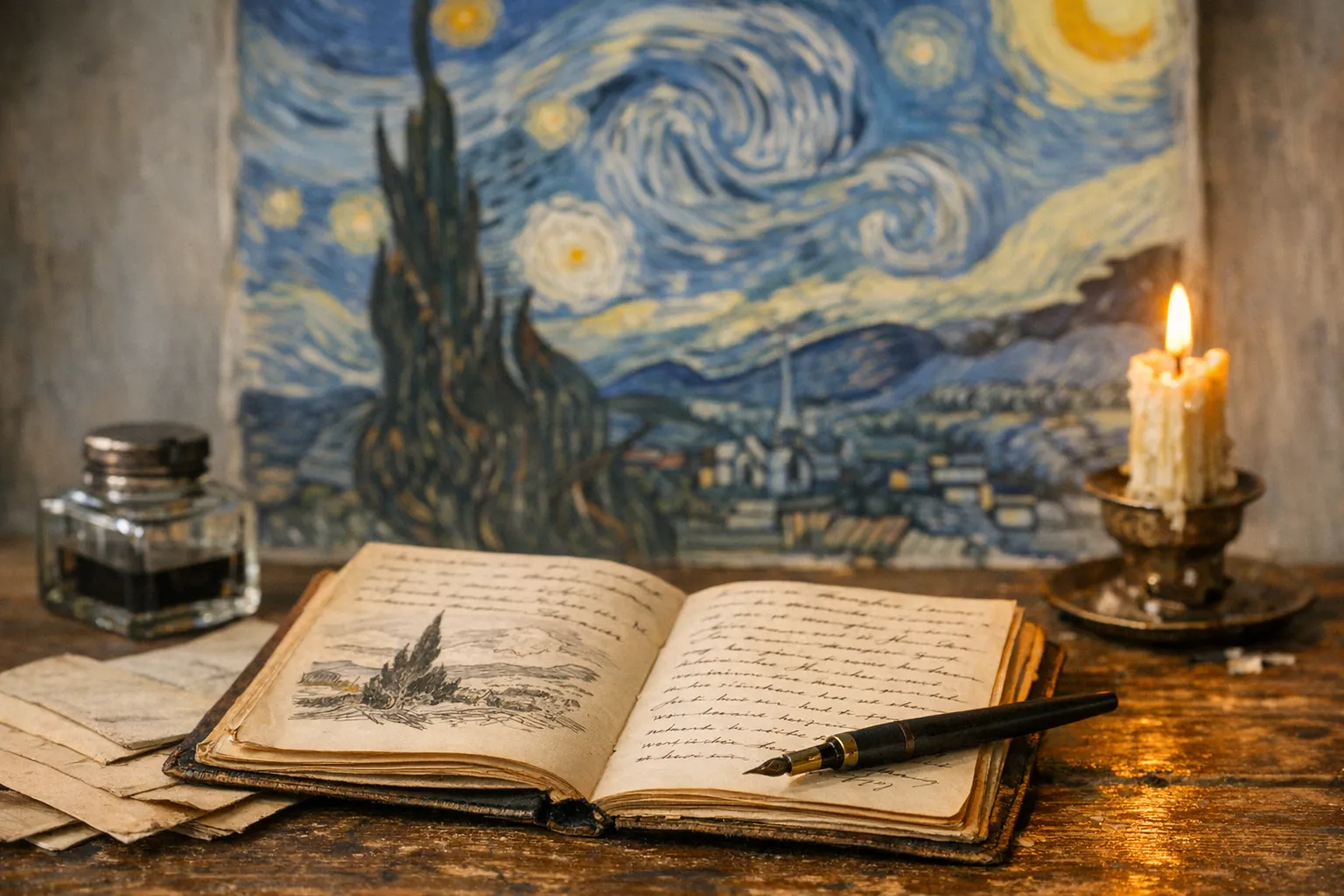
In this article, we will delve into the emotional and psychological layers of 'The Starry Night' as revealed through Van Gogh's intimate correspondence with his brother Theo. By examining his letters, we will uncover the artist's fascination with the night sky and how it reflects his inner turmoil, offering insights that enrich our understanding of one of history's most celebrated paintings.
The Context of Creation: Van Gogh's Life in the Asylum
Vincent van Gogh's time at the Saint-Paul-de-Mausole asylum in Saint-Rémy-de-Provence during 1889 marked a pivotal chapter in his life and artistry. He entered the asylum voluntarily, seeking respite from his tumultuous mental health struggles. This period was not just a retreat; it was an intense time of creation and reflection.
The landscape surrounding the asylum profoundly influenced his work. From his east-facing window, he captured the view of a swirling night sky, which would become the focal point of 'The Starry Night.' In a letter dated June 18, 1889, he referred to it as a "night study," signaling his fascination with the celestial. He wrote to Theo, expressing a need for "a starry night with cypresses," revealing how the night sky inspired his emotional landscape.
Van Gogh’s mental health was intricately tied to his artistic output. Scholars interpret the swirling sky and bold cypress tree in 'The Starry Night' as manifestations of his inner turmoil. Art historians have noted that these elements reflect themes of isolation and existential reflection, suggesting that his psychological state was both a catalyst and a constraint on his creativity.
As Van Gogh once compared his emotional state to the tumultuous skies he painted, he wrote, "It is like the wind blowing through the trees." This analogy highlights how his experiences shaped his art, making 'The Starry Night' a profound expression of his struggles.
The significance of the asylum's location cannot be overstated. It provided both the distance from societal pressures and the inspiration of nature, allowing Van Gogh to channel his emotions into one of his most iconic works, which, despite his doubts, has become a timeless masterpiece.
A Closer Look at 'The Starry Night'
Vincent van Gogh's 'The Starry Night' captivates viewers with its swirling sky, painted during his time at the Saint-Paul-de-Mausole asylum in June 1889. The sky is a symphony of deep blues and vibrant yellows, creating a dynamic movement that evokes both turbulence and beauty. This swirling pattern has been likened to the chaos found in molecular clouds, hinting at a deeper connection between Van Gogh's emotional state and the physical laws of nature.
The cypress tree, a dark and bold silhouette, dominates the foreground, reaching upwards like a fiery torch. Art historians interpret this element as symbolic of Van Gogh's struggles with isolation and existential reflection. The tree serves as a bridge between the earthly realm and the celestial, echoing themes of yearning and connection.
The stars and crescent moon shine brightly, their luminescence contrasting with the surrounding darkness. In his letters, Van Gogh expressed a profound fascination with the night sky, writing to Theo, “I need a starry night with cypresses or—perhaps above a field of ripe wheat; there are some really beautiful nights here.” This longing for beauty amidst chaos resonates deeply throughout the painting.
In essence, 'The Starry Night' is not just a depiction of a night scene; it’s an emotional landscape that encapsulates Van Gogh's inner turmoil. As one observer noted, “The painting is like an echo of a soul searching for peace in a storm.”
Through these visual elements, Van Gogh transports us into his psyche, leaving a lasting impression of both despair and hope.
Van Gogh's Letters: A Window into His Mind
Vincent van Gogh's correspondence with his brother Theo provides a profound glimpse into his emotional landscape, particularly regarding his iconic painting, The Starry Night. Written during his stay at the Saint-Paul-de-Mausole asylum in June 1889, his letters capture the essence of his thoughts and feelings.
In a letter dated June 18, 1889, Van Gogh referred to The Starry Night as a "night study," expressing his fascination with the night sky. He wrote, “I need a starry night with cypresses or—perhaps above a field of ripe wheat; there are some really beautiful nights here.” This reveals not only his longing for connection with nature but also his deep emotional resonance with the night.
Key excerpts from his letters highlight:
- Artistic Reflection: Van Gogh often discussed how nature influenced his work, emphasizing the importance of capturing emotional truths rather than mere appearances.
- Night Sky Significance: His descriptions of the night sky reflect his battle with mental health; the swirling patterns and vibrant stars symbolize both turbulence and beauty.
- Inner Turmoil: Art historians interpret the bold cypress tree and dynamic sky as manifestations of his inner struggles, with themes of isolation and existential contemplation.
As Van Gogh famously articulated, “The night is more colorful than the day.” This analogy encapsulates his belief that the night held a unique emotional depth, a sentiment that permeates The Starry Night. By examining his letters, we gain invaluable insight into how his emotional state shaped his artistic vision.
The Emotional Depth of 'The Starry Night'
Vincent van Gogh’s The Starry Night is a profound exploration of emotional and psychological themes, particularly isolation and existential reflection. Painted during his stay at the Saint-Paul-de-Mausole asylum in June 1889, the work serves as a visual representation of Van Gogh's internal struggles, communicated through his correspondence with his brother Theo.
Themes of Isolation and Existential Reflection
The painting captures a turbulent night sky that mirrors Van Gogh's own feelings of detachment. He often expressed a longing for connection, which is starkly juxtaposed with the vast, swirling cosmos depicted in the painting. In one letter, he wrote about needing “a starry night with cypresses,” indicating his deep fascination with the night sky as a source of solace amidst his turmoil.
Interpretations of the Swirling Patterns
The swirling patterns of the sky have been interpreted as manifestations of Van Gogh's inner turmoil. Art historians suggest that these dynamic shapes reflect his mental state, creating a sense of movement that evokes both chaos and beauty. As one analysis puts it, the sky resembles "turbulence found in molecular clouds," suggesting a connection between Van Gogh’s emotional landscape and the physical laws governing nature.
Connections to Van Gogh's Mental Health Struggles
Van Gogh’s letters reveal his ongoing battle with mental health, allowing us to view The Starry Night not just as a landscape but as a canvas of his psyche. The bold cypress tree, reaching toward the sky, symbolizes both a yearning for transcendence and a deep-rooted connection to the earth. As he described his work, it became clear that he was not merely painting a scene, but rather expressing his emotional state—“like a cry from the heart.”
In essence, The Starry Night stands as a poignant testament to Van Gogh's emotional depth, capturing both his struggles and his remarkable ability to convey those feelings through art.
Artistic Techniques and Innovations
Vincent van Gogh's The Starry Night showcases a masterful blend of technique and emotion, revealing layers of the artist's psyche through his innovative approach to color and composition.
Use of Color and Brushwork
Van Gogh employed bold, vibrant colors to evoke feelings of intensity and depth. The rich blues and yellows contrast dramatically, creating a sense of movement and life within the night sky. His distinctive brushwork—characterized by thick, expressive strokes—adds a tactile quality, making the painting almost pulsate with emotion. As he wrote to Theo, “I need a starry night with cypresses... there are some really beautiful nights here,” indicating his desire to capture the beauty and complexity of the night.
Influence of Impressionism and Post-Impressionism
While drawing inspiration from Impressionism, Van Gogh transcended its principles by infusing his work with emotional resonance. He departed from mere representation of light and color, instead prioritizing how these elements could convey his internal struggles. His approach aligns with Post-Impressionist techniques, which focus on personal expression and symbolic content.
Innovative Composition
The composition of The Starry Night is strikingly unique. The swirling sky, filled with tumultuous clouds and a bright crescent moon, dominates the canvas. This turbulence is not just aesthetic; it mirrors Van Gogh's mental state, embodying themes of isolation and existential reflection. Art historians interpret this dynamic as a visual representation of his inner turmoil, a sentiment echoed in his letters, where he often reflected on his feelings of loneliness and despair.
In essence, the painting is not merely a depiction of a night scene but rather an emotional landscape, capturing the essence of Van Gogh's complex psyche during a pivotal moment in his life.
Myth vs. Reality: Common Misconceptions about Van Gogh
Vincent van Gogh's life is often overshadowed by myths that paint him as a madman whose struggles defined his art. While it’s true that he faced significant mental health challenges, reducing his genius to mere madness overlooks the profound emotional depth of his work, particularly in pieces like The Starry Night.
-
The Myth of Madness: The narrative that Van Gogh’s mental instability was solely a negative trait simplifies a complex individual. His struggles provided a unique lens through which he viewed the world, infusing his artwork with raw emotion and intensity. Van Gogh once expressed that his art needed to be "like a cry from the heart," illustrating how his experiences shaped his creative voice.
-
Artistic Genius Amid Struggles: Far from being a detriment, Van Gogh’s psychological battles fueled his creativity. In his letters to Theo, he frequently discussed his fascination with the night sky, as seen when he wrote, "I need a starry night with cypresses or—perhaps above a field of ripe wheat." This passion led to the creation of The Starry Night, which is now celebrated as a pinnacle of Post-Impressionist art.
-
Misconceptions about His Relationship with Theo: Many assume that Van Gogh's relationship with his brother was solely one of dependence. In reality, Theo was a crucial supporter and confidant, providing not just financial assistance but also emotional encouragement. Their correspondence reveals a deep bond, with Theo often acting as Van Gogh’s sounding board for artistic ideas.
As Van Gogh’s letters reveal, he saw beauty and meaning in the chaos around him. To him, the night sky wasn't just a backdrop, but a canvas for his struggles and aspirations. As one art historian aptly put it, “Van Gogh’s art is not a reflection of his madness; it’s a vibrant dialogue with his soul.”
The Scientific Perspective: Turbulence in Art
Recent studies have begun to explore the intriguing intersection of art and science, particularly in the realm of Vincent van Gogh's 'The Starry Night.' Scholars have noted that the painting's swirling patterns bear a striking resemblance to molecular turbulence—a phenomenon observed in fluid dynamics. This connection offers a fresh lens through which to understand Van Gogh's emotional landscape and artistic vision.
-
Art and Science Synergy: Research has shown that the chaotic yet beautiful movement of the sky in 'The Starry Night' correlates with the turbulence found in molecular clouds. This suggests that Van Gogh may have intuitively grasped physical laws governing turbulent flows, using them as a foundation for his artistic expression.
-
Visual Turbulence: The painting’s dynamic swirls evoke the kind of turbulence that occurs in nature, like the spirals of a galaxy or the eddies in a flowing river. This parallel not only enhances our appreciation of Van Gogh's technique but also opens up discussions about his psychological state during the creation of this masterpiece.
-
Implications for Understanding Van Gogh: By likening the swirling sky to natural turbulence, we gain deeper insights into Van Gogh's emotional turmoil. As he wrote to Theo, “I need a starry night with cypresses or—perhaps above a field of ripe wheat; there are some really beautiful nights here.” This longing for beauty amidst chaos may have found its perfect expression in the painting.
Ultimately, the scientific analysis of 'The Starry Night' enriches our understanding of Van Gogh, revealing the complex interplay between his mental struggles and the natural world, all captured in a mesmerizing swirl of paint.
Cultural Impact and Legacy of 'The Starry Night'
Vincent van Gogh's The Starry Night has transcended its origins to become one of the most iconic works of art in history. Created in June 1889 during his stay at the Saint-Paul-de-Mausole asylum, this painting captures a swirling night sky filled with stars and a crescent moon, viewed from Van Gogh's asylum room window. Its profound emotional depth resonates with viewers, making it a staple in discussions of art and mental health.
The painting's influence extends beyond the canvas, inspiring countless modern artists and permeating pop culture. For instance, references to The Starry Night can be found in music, literature, and even fashion. Artists like Edvard Munch and contemporary creators often cite Van Gogh’s swirling skies as a significant influence in their works. The painting serves as a metaphor for emotional turbulence, which resonates deeply in today's discussions around mental health.
Moreover, The Starry Night plays a crucial role in Van Gogh's legacy. Despite his initial criticism of the work—he described it as a mere "night study" in a letter to his brother Theo—its current status as a masterpiece underscores the evolving nature of art appreciation. As art historian John Kirchner noted, “The Starry Night is like a window into Van Gogh’s soul, revealing the chaos and beauty of his mind.”
In essence, The Starry Night is not just a painting; it's a cultural phenomenon that continues to inspire and evoke introspection, showcasing the lasting impact of Van Gogh’s emotional and psychological expressions.
Frequently Asked Questions about 'The Starry Night'
What inspired Van Gogh to paint 'The Starry Night'?
Vincent van Gogh painted 'The Starry Night' in June 1889 during his stay at the Saint-Paul-de-Mausole asylum in Saint-Rémy-de-Provence. The painting was inspired by the view from his east-facing window just before sunrise, infused with his emotional experiences. In a letter to his brother Theo, he expressed his fascination with the night sky, stating, "I need a starry night with cypresses or—perhaps above a field of ripe wheat; there are some really beautiful nights here."
How does the painting reflect Van Gogh's mental state?
The swirling sky and bold cypress tree in 'The Starry Night' have been analyzed by art historians as representations of Van Gogh's inner turmoil and mental struggles. The turbulence in the sky mirrors the chaos he felt within, reflecting themes of isolation and existential reflection. His letters reveal a man grappling with his mental health, providing a poignant backdrop to the painting's emotional depth.
What techniques did Van Gogh use in this artwork?
Van Gogh employed several notable techniques in 'The Starry Night':
- Impasto: Thick layers of paint create texture, making the stars and sky come alive.
- Color Theory: He used contrasting colors to evoke emotion and depth, with vibrant yellows against deep blues.
- Swirling Forms: The characteristic swirling patterns in the sky resemble turbulence in nature, suggesting a connection to physical laws governing turbulent flows.
In Van Gogh's own words, the painting can be likened to "a dream that is both a reflection of reality and an escape from it."
Conclusion: The Enduring Power of 'The Starry Night'
Vincent van Gogh's 'The Starry Night' stands as a poignant testament to his emotional and artistic journey. Painted during a tumultuous period in his life while he was at the Saint-Paul-de-Mausole asylum, the artwork captures not only the beauty of the night but also the deep psychological struggles that plagued him. Through his letters to his brother Theo, we gain invaluable insight into Van Gogh's mind, revealing how he sought solace in the night sky.
The painting resonates profoundly in today's discussions around mental health. Its swirling patterns can symbolize the chaos and turbulence often associated with mental illness, making it a powerful visual metaphor for those grappling with similar feelings. As art historian interpretations suggest, the bold cypress tree and the animated sky embody Van Gogh's existential reflections and isolation, inviting viewers to empathize with his struggles.
In his own words, Van Gogh described the night sky as a "night study," highlighting his fascination with its beauty and complexity. He wished for a "starry night with cypresses," expressing a longing that transcends time. This longing reminds us that art can serve as a bridge between the artist’s internal world and the viewer's experience.
As we reflect on 'The Starry Night,' we see not just a masterpiece of Post-Impressionism, but a profound exploration of emotional depth. Van Gogh's legacy lives on, reminding us that art can capture the essence of the human experience, illuminating both darkness and beauty.
"The swirling sky is like a tumultuous ocean, reflecting the depths of Van Gogh’s turbulent soul."