
Vincent van Gogh's 'Starry Night' is more than just a beautiful painting; it's a window into the artist's tumultuous mind. Created during his stay at an asylum, the work captures the essence of his mental health struggles while simultaneously showcasing his unique artistic vision.
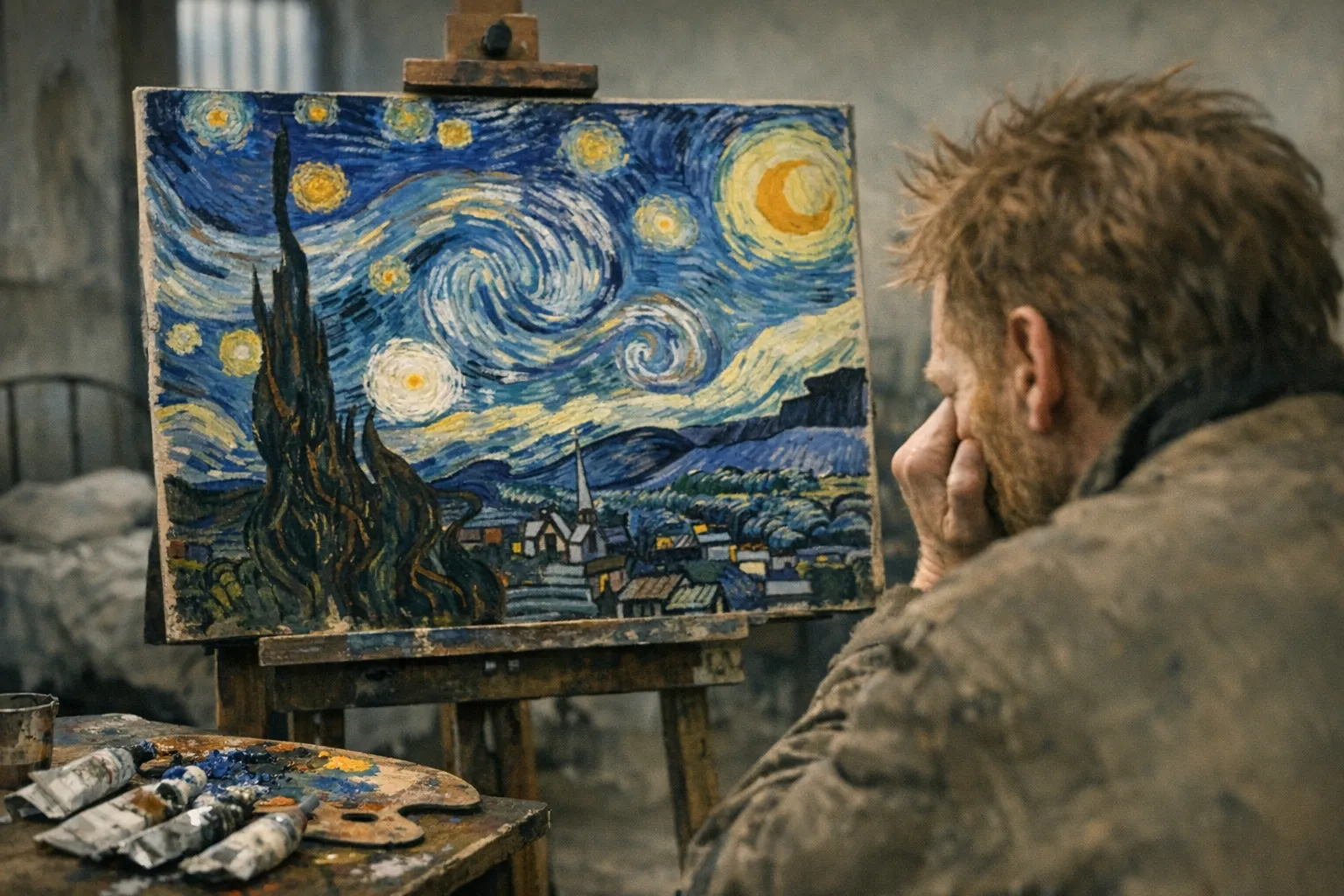
In this exploration, we'll delve into how 'Starry Night' serves as a poignant reflection of Van Gogh's emotional state. From the swirling skies that echo his inner turmoil to the symbolic cypress trees that represent mortality, this iconic piece reveals the intricate relationship between art and mental health. By examining the layers of meaning within 'Starry Night,' we can gain a deeper understanding of Van Gogh's legacy and the profound impact of his experiences on his art.
The Context of Creation: Van Gogh's Life and Mental Health
Vincent van Gogh's creation of Starry Night in June 1889 is deeply intertwined with his tumultuous mental health. His struggles with episodes of psychosis and self-harm compelled him to voluntarily seek treatment at the Saint-Paul-de-Mausole asylum in Saint-Rémy-de-Provence, France. During this period, he faced profound emotional turmoil, which directly influenced his artistic expression.
Living in the asylum provided Van Gogh with a unique, albeit challenging, vantage point. The painting itself depicts the view from his room, showcasing a swirling night sky filled with vibrant colors and exaggerated forms. This environment became a canvas for his emotional state, where he transformed his inner chaos into visual art. As art historians have noted, the swirling sky can be seen as a representation of his heightened emotional and perceptual experiences.
- Mental Health Struggles: Van Gogh's well-documented issues included severe depression and anxiety, which often clouded his creative process.
- Saint-Paul-de-Mausole Asylum: His stay there from May 1889 to May 1890 marked a period of intense artistic output despite his personal battles.
- Environmental Influence: The serene yet isolating landscape of Saint-Rémy allowed him to explore the interplay between reality and imagination.
Van Gogh once likened his emotional state to "a stormy sea," suggesting that his mental health struggles were a constant turbulence in his life. This analogy reflects how deeply his internal conflicts influenced his work.
The cypress tree in Starry Night, often interpreted as a symbol of mourning and eternity, further illustrates his contemplation of mortality. Despite the painting's later acclaim, Van Gogh himself viewed it as a failure, revealing the persistent discord between his self-perception and the external recognition of his artistry.
A Visual Analysis of 'Starry Night'
Vincent van Gogh's Starry Night is a compelling exploration of the night sky, characterized by swirling patterns that evoke both chaos and beauty. The swirling sky, with its exaggerated forms, suggests a world in flux, mirroring Van Gogh's emotional landscape. This dynamic movement draws the viewer into a whirlwind of feelings, capturing the intensity of his mental state during a turbulent period in his life.
Color Choices and Brushstrokes
Van Gogh's use of color in Starry Night is striking. The vivid blues and yellows create a stark contrast that enhances the painting's emotional impact. Thick brushstrokes contribute to the sense of turbulence, with each stroke reflecting his inner turmoil. As art historians have noted, these choices can be seen as a visual representation of his heightened emotional and perceptual states. The vibrant colors resonate with the intensity of his experiences, illustrating his struggle with mental health.
Symbolism of the Cypress Tree
In the foreground, the cypress tree stands tall, often interpreted as a symbol of mourning and eternity. This element deepens the emotional resonance of the piece, connecting Van Gogh’s contemplation of mortality with the swirling cosmos above. The tree’s dark silhouette contrasts sharply with the luminous sky, emphasizing the tension between life and death. As one analyst remarked, “It’s as if the cypress reaches for the stars, seeking solace in the chaos above.”
In summary, Starry Night is not just a visual masterpiece; it encapsulates the interplay between Van Gogh's artistic vision and his mental health struggles, making it a profound commentary on the human experience.
The Emotional Landscape: Interpreting the Swirls
The swirling patterns in Vincent van Gogh's Starry Night serve as a profound reflection of his emotional turmoil during a turbulent period of his life. Painted in June 1889 at the Saint-Paul-de-Mausole asylum, the night sky is not merely a backdrop; it encapsulates Van Gogh's heightened emotional and perceptual states.
-
Connection to Emotional Turmoil: The vigorous, swirling brushstrokes mirror Van Gogh’s internal chaos. Art historians suggest that these dynamic patterns represent the artist's struggle with his mental health, evoking feelings of anxiety and existential reflection.
-
Art Historians' Interpretations: Experts have long debated the significance of the swirling sky. Some argue that it embodies a sense of movement, as if the cosmos is alive and in flux. "The sky is a vast ocean of emotion," one historian noted, highlighting the way Van Gogh translates his inner experiences into visual language.
-
Mathematical Models of Fluid Turbulence: Recent analyses suggest that the patterns in Starry Night resemble mathematical models of fluid turbulence. This connection implies that Van Gogh possessed an almost intuitive understanding of complex natural phenomena, allowing him to weave intricate emotions into his art.
The cypress tree in the foreground, often associated with mourning and eternity, further deepens the emotional landscape of the painting. Through vibrant colors and thick brushstrokes, Van Gogh not only expresses his artistic vision but also invites viewers to engage with the complexities of mental health and emotional depth.
Symbolism in 'Starry Night': The Cypress Tree
The cypress tree in Vincent van Gogh's 'Starry Night' serves as a powerful symbol of mourning and eternity. Positioned prominently in the foreground, it contrasts starkly with the swirling, vibrant sky—a visual representation of Van Gogh's emotional and perceptual states during a turbulent time in his life.
Van Gogh's fascination with the cypress can be traced to his own contemplation of mortality. He frequently grappled with thoughts of death, which is evident in his correspondence with his brother, Theo. In one letter, he likens life to "a fleeting shadow," reflecting a persistent awareness of his own fragility. This analogy encapsulates the somber undertones often associated with the cypress tree, a plant traditionally linked to graveyards and remembrance.
- Cypress Tree Symbolism: Represents both mourning and the eternal cycle of life.
- Personal Reflection: Van Gogh's letters reveal a deep-seated preoccupation with death, indicating how these thoughts influenced his art.
- Artistic Context: Painted during his time at the Saint-Paul-de-Mausole asylum, 'Starry Night' merges his psychological struggles with artistic expression.
The cypress in the painting serves as more than just a backdrop; it embodies Van Gogh's emotional struggle, intertwining his artistic vision with his mental health challenges. This complex relationship between art and mental health is crucial to understanding the depth of 'Starry Night.'
The Post-Impressionist Style: Techniques and Intentions
Vincent van Gogh’s Starry Night is a quintessential example of post-impressionism, where technique and emotional expression intertwine. The painting showcases Van Gogh's signature thick brushstrokes and vibrant colors, creating a visual symphony that captures both the beauty and turmoil of his psyche.
-
Thick Brushstrokes: Van Gogh employed impasto techniques, layering paint to give the canvas a tactile quality. This approach creates a sense of movement and energy, as seen in the swirling skies that dominate the composition.
-
Vibrant Colors: The bold use of color is not merely decorative; it conveys emotional intensity. The rich blues and yellows pulsate with life, reflecting Van Gogh's heightened emotional states during his time in the asylum. Art historians often interpret these swirling patterns as a representation of his inner turmoil and perceptual experiences.
The emotional depth present in Starry Night can be compared to other post-impressionist works, such as Paul Cézanne's landscapes or Georges Seurat's pointillism. While Cézanne focuses on structure and form, and Seurat emphasizes color theory, Van Gogh's style communicates raw emotion, making his work feel immediate and visceral.
As one art critic noted, "Van Gogh paints not the world as it is, but the world as it feels." This analogy encapsulates the essence of his work, illustrating how his emotional struggles influenced his artistic vision.
The cypress tree, a prominent feature in the foreground, symbolizes death and eternity, further deepening the emotional resonance of the painting. Van Gogh's ability to merge his personal experiences with artistic expression showcases the profound connection between art and mental health, making Starry Night not just a painting, but a poignant narrative of his life.
Van Gogh's Self-Perception: A Failed Masterpiece?
Vincent van Gogh's relationship with Starry Night is complex and steeped in contradiction. While the artwork is celebrated as a masterpiece of post-impressionism, Van Gogh himself viewed it with criticism. In letters to his brother Theo, he expressed dissatisfaction, stating that the painting didn’t live up to his artistic ambitions. This self-doubt is a recurring theme in Van Gogh's life, reflecting a broader struggle with mental health.
-
Public Acclaim vs. Personal Views: Despite being hailed as a groundbreaking work, Van Gogh considered Starry Night a failure. This disconnect illustrates the often harsh reality of artistic self-perception. While audiences were mesmerized by the swirling skies and vibrant colors, Van Gogh's internal dialogue was marked by disappointment.
-
Impact of Self-Criticism: Van Gogh’s relentless self-criticism impacted his legacy, leading him to underestimate the significance of his contributions. His mental health struggles, including episodes of psychosis, often clouded his ability to see the beauty in his own work. As he once poignantly noted, creating art felt like "a battle against the darkness"—a metaphor that encapsulates his internal turmoil.
Ultimately, Starry Night serves as a poignant reminder that the artist's perception of their work can be vastly different from the public’s admiration. The emotional depth embedded in the painting—a blend of reality and imagination—mirrors Van Gogh's complex psyche, making it a symbol of both his genius and his struggles.
The Legacy of 'Starry Night': Cultural Impact and Reception
Initially met with indifference, Vincent van Gogh's Starry Night has evolved into one of the most celebrated works in art history. When it was first exhibited in 1889, critics did not grasp its significance, viewing it as an oddity rather than a masterpiece. Fast forward to today, and it’s a cornerstone of modern art, influencing countless artists and movements.
Influence on Contemporary Artists
Starry Night has left an indelible mark on contemporary art. Artists like Yayoi Kusama and Jackson Pollock have drawn inspiration from Van Gogh's vibrant colors and dynamic forms. The painting's swirling patterns have even been linked to modern abstract art, showcasing how Van Gogh's emotional intensity transcends time and style.
Cultural References in Media and Literature
The impact of Starry Night extends beyond the canvas. It has become a cultural touchstone, referenced in films, literature, and music. For instance, in Don McLean’s song “Vincent,” the lyrics evoke the emotional landscape of Van Gogh's life and art, providing a poignant connection between his struggles and his creativity. As one critic aptly noted, "Van Gogh's stars are not just in the sky; they're in the hearts of those who feel lost."
In literature, numerous essays and novels explore the themes of mental health and artistic vision through the lens of Van Gogh's life, making Starry Night a symbol of the profound connection between creativity and emotional turmoil.
Conclusion
The legacy of Starry Night showcases not just Van Gogh’s artistic genius, but also the enduring dialogue between art and mental health. Its initial reception may have been lukewarm, but its modern acclaim is a testament to the transformative power of art in understanding the human condition.
Mental Health and Art: A Broader Perspective
Art serves as a powerful lens through which we can examine the complexities of mental health. Vincent van Gogh's Starry Night is a prime example, capturing his emotional turmoil during a pivotal time in his life. Painted in June 1889 while he was at the Saint-Paul-de-Mausole asylum, the swirling skies and vibrant colors reflect his heightened emotional states and struggles with mental health.
Many artists have faced similar challenges, using their craft as a means of expression and understanding. For instance:
- Edvard Munch: His iconic work, The Scream, expresses profound anxiety and despair.
- Frida Kahlo: Her self-portraits often explored themes of pain and identity, deeply rooted in her own physical and emotional struggles.
- Vincent van Gogh: Despite his eventual acclaim, he viewed Starry Night as a failure, revealing the disconnect between an artist's perception and societal recognition.
Art not only acts as a form of catharsis for the creator but also fosters empathy and understanding in viewers. As the poet John Keats famously said, “A thing of beauty is a joy forever,” illustrating how art can encapsulate deep emotional experiences and resonate across time.
The vibrant brushstrokes in Starry Night and the cypress trees symbolizing mortality invite us to reflect on our own mental landscapes. By studying these works, we gain insights into the human condition, making art an invaluable tool in the conversation surrounding mental health.
Myths vs. Reality: Common Misconceptions about Van Gogh
Vincent van Gogh is often romanticized as the quintessential tortured artist, but many misconceptions surround both his life and his masterpiece, Starry Night.
Debunking Myths
One pervasive myth is that Van Gogh cut off his ear due to a love affair with a woman. In reality, this incident stemmed from a volatile relationship with fellow artist Paul Gauguin and heightened emotional distress. Understanding these details humanizes Van Gogh beyond the myth of the tragic genius.
The Reality of His Mental Health Struggles
Van Gogh’s mental health issues, including episodes of psychosis and self-harm, are well-documented. His voluntary admission to the Saint-Paul-de-Mausole asylum in June 1889 was a response to these struggles. While Starry Night reveals a swirling, vibrant cosmos, it also mirrors his internal chaos.
In Van Gogh's words, he felt like “a broken vessel” during these times, reflecting the dissonance between his artistic vision and personal torment.
Understanding the Artist Beyond the Myth
While many view Starry Night as a triumph, Van Gogh himself considered it a failure, expressing dissatisfaction in letters to his brother, Theo. This perspective shifts our understanding of the painting from mere aesthetic appreciation to a poignant reflection of his struggles.
Moreover, the cypress trees in the foreground symbolize death and eternity, underscoring his contemplation of mortality. Thus, Starry Night is not just a depiction of a starry sky but a visual representation of Van Gogh's profound emotional and perceptual states.
By separating myth from reality, we can appreciate Van Gogh's work as both an artistic achievement and a testament to the complexities of mental health.
Conclusion: The Enduring Power of 'Starry Night'
Vincent van Gogh's 'Starry Night' is more than just a visual masterpiece; it serves as a profound reflection of his mental health struggles and artistic vision. Key themes arise from the painting, including the tension between reality and imagination, as seen in the swirling sky and exaggerated colors. The cypress tree, a poignant symbol of mortality and eternity, further underscores Van Gogh’s contemplation of life and death during his time at the asylum.
Today, 'Starry Night' resonates with audiences worldwide, reminding us of the complex relationship between art and mental health. It invites viewers to explore their own emotional landscapes, much like Van Gogh did. The painting’s capacity to evoke feelings of awe and introspection is timeless, making it relevant in discussions about mental health even today.
In reflecting on Van Gogh's life and his artistic journey, one might say that art is like a mirror held up to the soul. As Van Gogh himself expressed, “Art is a way of recognizing oneself.” This encapsulates the essence of 'Starry Night'—a vivid portrayal of personal turmoil that transcends time, encouraging us to engage with our own experiences and emotions. Ultimately, it highlights how art can serve as both a refuge and a means of understanding our shared human condition.