
Vincent van Gogh's The Starry Night is more than just a painting; it is a vivid reflection of the artist's inner world, marked by emotional intensity and psychological struggle. Created during his stay at the Saint-Paul-de-Mausole asylum in June 1889, the artwork captures the tumultuous intersection of mental health and creativity.
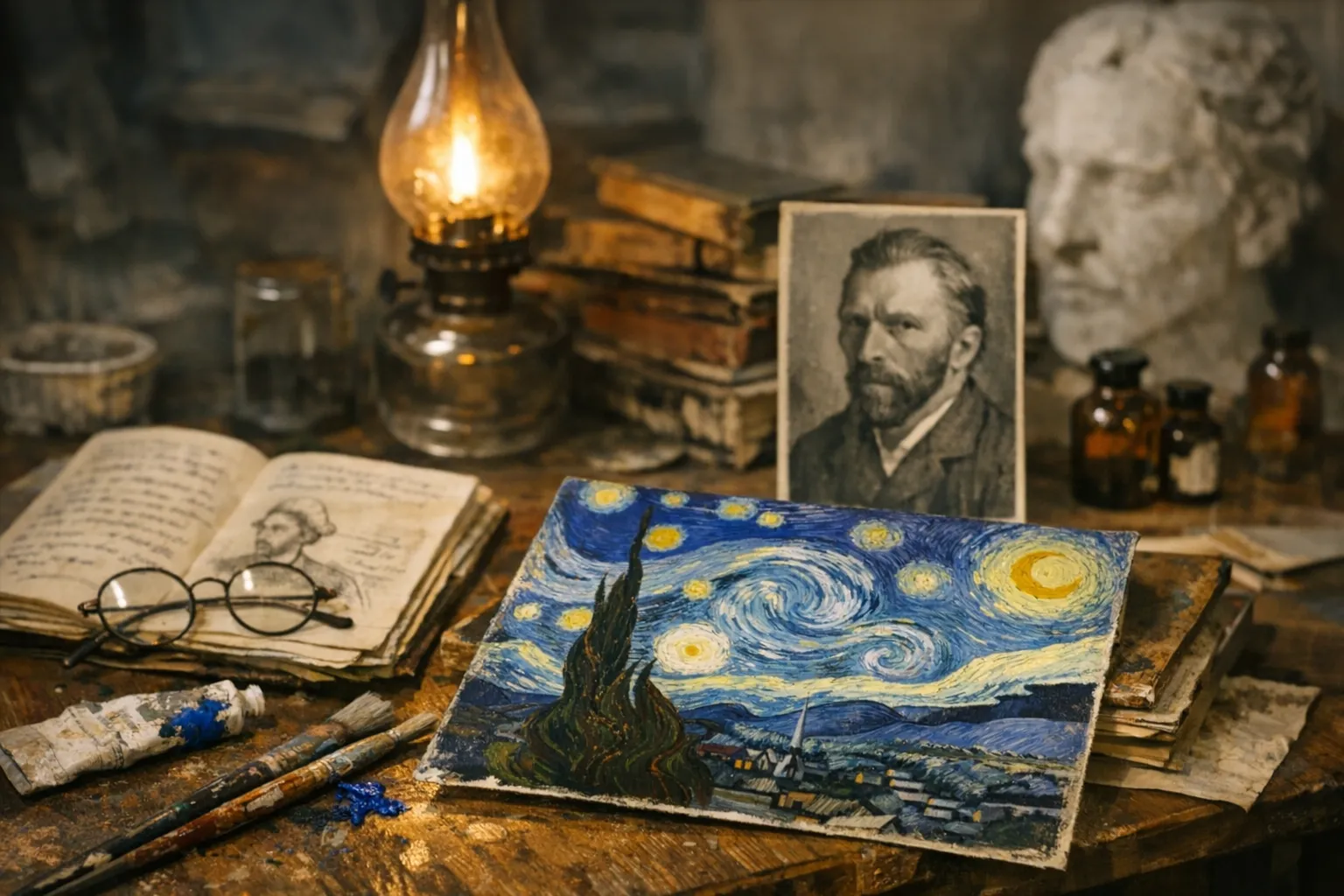
In this analysis, we will delve into how Van Gogh's deteriorating mental state influenced his artistic expression, particularly in The Starry Night. We will explore the swirling night sky and bold colors that have made this piece a hallmark of Post-Impressionism, while also examining how the artist's own interpretations of his work reveal a complex relationship between suffering and creativity. Through this lens, we aim to uncover the profound impact of mental health on artistic expression and the legacy left by one of history's most iconic figures.
The Context of Creation: Van Gogh's Life in the Asylum
Vincent van Gogh painted The Starry Night in June 1889 during his stay at the Saint-Paul-de-Mausole asylum in Saint-Rémy-de-Provence, France. This period was marked by a significant decline in his mental health, leading to episodes of psychosis and self-harm.
From his asylum room, Van Gogh had a unique vantage point of a swirling night sky filled with luminous stars and a crescent moon. This view was not merely a landscape; it became a canvas for his emotional state. Art historians often interpret the painting's vibrant colors and dynamic patterns as direct expressions of his inner turmoil.
In a letter to his brother Theo, Van Gogh reflected on his struggles with mental illness, noting, “I feel like a broken tree in a storm.” This analogy captures the distress that permeated his life and work during this time.
Despite its eventual acclaim, Van Gogh considered The Starry Night a 'failure' and was critical of the painting. The village depicted in the artwork is an imaginary addition, crafted from sketches rather than the actual landscape outside his window. The cypress trees, exaggerated in scale, were viewed by him in aesthetic terms, showcasing his complex relationship with nature and his own psyche.
Ultimately, The Starry Night stands not just as a masterpiece of Post-Impressionism but also as a poignant testament to Van Gogh's emotional struggles—an intersection of mental health and artistic expression that continues to resonate with audiences today.
Visual Elements: Analyzing the Painting's Composition
The visual components of The Starry Night are not merely aesthetic choices but profound reflections of Vincent van Gogh's emotional landscape. Painted in June 1889 during his stay at the Saint-Paul-de-Mausole asylum, the artwork features a swirling night sky filled with luminous stars and a crescent moon. This dynamic sky symbolizes Van Gogh's emotional intensity, capturing the turmoil he experienced during this tumultuous period of his life.
The cypress trees in the foreground stand tall and exaggerated in scale. Van Gogh’s choice to amplify their size serves to showcase his unique aesthetic vision and emotional response to nature. The cypress, often associated with death, hints at his struggles with mental health, weaving the somber elements of his psyche into the fabric of the painting.
Interestingly, the village depicted in The Starry Night is an imaginary construct, based more on Van Gogh's sketches than the actual landscape visible from his asylum room. This creative liberty illustrates how he transformed reality through his art, crafting a world that both reflects and distorts his inner turmoil.
As art historian Richard Thomson aptly put it, "Van Gogh's brush dances across the canvas, a whirlwind of emotion captured in paint." This analogy encapsulates the vividness and dynamism present in the painting, where color and form collide to express the artist's psychological state.
In summary, the swirling patterns and vibrant colors of The Starry Night are not just visual elements; they are integral to understanding Van Gogh's emotional experiences and his struggle with mental health. The artwork stands as a testament to how personal suffering can give rise to profound artistic expression.
Van Gogh's Self-Critique: A Study of Perception
Vincent van Gogh's relationship with his own work, particularly 'The Starry Night,' reveals a profound struggle with self-worth and artistic validation. Despite the painting's current acclaim, Van Gogh himself dismissed it as a "failure" in letters to his brother, Theo. This self-critique highlights the intense emotional turmoil he experienced during his time at the Saint-Paul-de-Mausole asylum in Saint-Rémy-de-Provence, where he created the piece in June 1889.
In his correspondence, Van Gogh expressed dissatisfaction with the swirling sky and the exaggerated cypress trees, which he viewed primarily through an aesthetic lens. He felt these elements did not meet his expectations, reflecting a pervasive sense of inadequacy. Understanding Van Gogh's perception of 'The Starry Night' adds depth to its emotional weight, allowing viewers to appreciate the layers of struggle embedded within the vibrant colors and dynamic forms.
As art historians note, the painting's swirling patterns and bold hues serve as expressions of Van Gogh's inner turmoil. He described his feelings as akin to "a starry night filled with restless dreams," illustrating how his mental state deeply influenced his artistic expression.
This lens into his psyche not only enhances our appreciation of 'The Starry Night' but also serves as a reminder of the complex interplay between mental health and creative output. Ultimately, Van Gogh's critique of his own work invites us to reconsider our understanding of artistic success and the often turbulent journey behind it.
Emotional Turmoil: The Psychological Underpinnings of the Art
Vincent van Gogh’s The Starry Night is not just a visual spectacle; it encapsulates the depths of his emotional struggles during a tumultuous period. Painted in June 1889 while he was confined at the Saint-Paul-de-Mausole asylum, this artwork serves as a poignant visual diary of his psychological state.
Art historians often interpret the painting's swirling patterns and vibrant colors as direct expressions of Van Gogh's emotional turmoil. The chaotic night sky, filled with luminous stars and a crescent moon, mirrors his intense inner life. Each brushstroke can be seen as a reflection of his deteriorating mental health, which included episodes of psychosis and self-harm during his time in the asylum.
- Swirling Patterns: The dynamic movement in the sky suggests restlessness and anxiety.
- Vibrant Colors: The bold use of ultramarine and cobalt blue evokes feelings of both calm and turmoil.
- Imaginary Landscape: The village depicted is a product of Van Gogh's imagination, signifying a longing for stability amidst chaos.
Exploring these connections enhances our understanding of the artwork's significance. As Van Gogh himself wrote, “This painting is like a dream; it reflects my soul.” The cypress trees in the foreground, exaggerated in scale and viewed primarily in aesthetic terms, further illustrate his complex relationship with reality.
In essence, The Starry Night transcends traditional artistic boundaries, inviting viewers to explore the complex interplay of mental health and artistic expression. It remains a testament to how profound emotional experiences can shape remarkable art.
Scientific Insights: The Materials Behind the Masterpiece
The scientific analysis of Vincent van Gogh's The Starry Night reveals fascinating details about the materials he used, shedding light on his artistic choices and techniques. Researchers have confirmed that Van Gogh employed ultramarine and cobalt blue for the swirling night sky, creating a vibrant canvas that mirrors his emotional intensity during his time in the Saint-Paul-de-Mausole asylum.
In addition to the blues, Van Gogh used Indian yellow and zinc yellow for the stars and crescent moon. These choices contribute significantly to the painting's luminescence, making the celestial bodies appear almost alive against the deep blue backdrop. Understanding these materials not only highlights Van Gogh's technical prowess but also underscores how he harnessed color to convey his psychological state.
As art historian Richard Dorment once remarked, "Colors in Van Gogh's palette were like notes in a symphony, each one playing its part in the emotional cadence of his work."
Key takeaways from the scientific insights include:
- Ultramarine and Cobalt Blue: Essential for the sky, enhancing emotional depth.
- Indian and Zinc Yellow: Used for the stars and moon, fostering vibrancy.
- Material Choices: Reflect Van Gogh's artistic techniques and emotional landscape.
By analyzing these materials, we gain a deeper understanding of how Van Gogh's fluctuating mental state informed his creative output, transforming personal turmoil into a timeless masterpiece.
The Legacy of 'The Starry Night': Influence on Future Artists
'The Starry Night' remains a cornerstone of Western art, not just for its beauty but for its profound impact on generations of artists. Painted in June 1889 during Van Gogh's stay at the Saint-Paul-de-Mausole asylum, this masterpiece captures a swirling night sky filled with luminous stars and a crescent moon, reflecting the artist's emotional intensity and struggles with mental health.
Its influence has permeated various art movements, inspiring artists from Expressionism to Surrealism. The bold colors and dynamic brushwork have been emulated by countless creators who seek to channel emotional depth through their art. For example:
- Expressionists like Edvard Munch took cues from Van Gogh’s emotive use of color to explore human angst.
- Abstract artists, such as Wassily Kandinsky, drew inspiration from the painting’s vibrant swirls to emphasize color as a vehicle for expression.
The painting's enduring relevance is evident in contemporary art as well. Numerous artists reference 'The Starry Night' or incorporate its motifs, showcasing how it transcends time and style.
As art historian Robert Hughes once said, “The Starry Night is to art what a black hole is to the universe: a point of gravitational pull that draws everything into its orbit.” This analogy underscores the painting's magnetic influence on artistic expression.
In summary, 'The Starry Night' is not merely a masterpiece of Post-Impressionism; it serves as a beacon for artistic exploration, inviting future generations to engage with their emotional landscapes. The legacy of Van Gogh’s vision continues to inspire and challenge artists to this day.
Myth vs. Reality: Common Misconceptions About Van Gogh
Vincent van Gogh's legacy often conjures images of madness and despair, leading many to believe he was entirely mad. However, this simplistic view overlooks the complexity of his character. Van Gogh was not just a tormented soul; he was a deeply reflective artist who sought to understand his emotional landscape through his work.
One common misconception is that he painted The Starry Night solely during a psychotic episode. While it's true that his mental health deteriorated during his stay at the Saint-Paul-de-Mausole asylum in Saint-Rémy-de-Provence, France, this painting reflects more than just a moment of instability. It was crafted in June 1889, drawing inspiration from his environment and emotional state rather than being a product of a single episode.
Understanding these myths helps appreciate the multifaceted nature of both Van Gogh's character and his work. As art historian Robert Hughes aptly noted, "His mind was like a kaleidoscope—beautifully intricate but often chaotic."
Key points to consider:
- Van Gogh viewed The Starry Night as a 'failure' in his letters to his brother, Theo, highlighting his critical self-reflection.
- The village depicted is an imaginary addition, suggesting a blend of reality and imagination in his art.
- The exaggerated cypress trees were primarily chosen for their aesthetic impact, not just for their emotional symbolism.
These insights reveal that Van Gogh's art represents a dialogue between his internal struggles and his artistic ambitions, making The Starry Night a profound exploration of the human condition.
The Role of Nature in Van Gogh's Artistic Expression
Nature played a pivotal role in Vincent van Gogh's artistic vision, particularly in "The Starry Night." Painted in June 1889 during his stay at the Saint-Paul-de-Mausole asylum, the work reflects a deep connection to the environment around him. Van Gogh's portrayal of the night sky is not merely a visual representation; it serves as an emotional outlet, channeling his inner turmoil into a vibrant depiction of the cosmos.
-
Connection to the Environment: The swirling night sky filled with luminous stars and a crescent moon captures Van Gogh's intimate relationship with nature. It’s as if he reached out to the universe, seeking solace amidst his struggles.
-
Emotional Response: The intensity of the swirling patterns and the bold colors are often interpreted as manifestations of Van Gogh's emotional state. As art historians note, these elements express his psychological challenges during a time of significant mental health deterioration.
-
Subject and Inspiration: Nature was both a subject of fascination and a source of inspiration for Van Gogh. The exaggerated cypress trees in the foreground, while aesthetically driven, also symbolize the artist's intertwining with the natural world. The village depicted is an imaginary construct, showcasing his artistic license to meld reality with personal vision.
As Van Gogh once poignantly expressed, "Art is to be a bridge between the inner and outer worlds." In "The Starry Night," this bridge is vividly illustrated through nature’s powerful influence on his emotional landscape. The painting stands as a testament to how deeply intertwined mental health and artistic expression can be, capturing a moment of beauty born from chaos.
FAQs: Understanding 'The Starry Night' and Van Gogh's Mind
What inspired Van Gogh to create 'The Starry Night'?
Vincent van Gogh painted 'The Starry Night' in June 1889 during his stay at the Saint-Paul-de-Mausole asylum in Saint-Rémy-de-Provence, France. The swirling night sky, filled with luminous stars and a crescent moon, was viewed from his asylum room window. This setting became a canvas for his emotional intensity, capturing both a serene landscape and the chaos in his mind.
How did Van Gogh's mental health affect his art?
Van Gogh's mental health significantly influenced his artistic expression. During his time at the asylum, he experienced episodes of psychosis and self-harm, which art historians interpret as reflections of his emotional turmoil. The vibrant colors and dynamic brushstrokes in 'The Starry Night' serve as a visual representation of his inner struggles. As one writer noted, "His paintings are like a scream captured on canvas."
What techniques did Van Gogh use in 'The Starry Night'?
Van Gogh employed several distinctive techniques in 'The Starry Night':
- Color Palette: He used ultramarine and cobalt blue for the sky, complemented by Indian yellow and zinc yellow for the stars and moon.
- Brushwork: The expressive brushstrokes create a sense of movement, contributing to the painting's emotional depth.
- Composition: The exaggerated cypress trees and imaginary village add to the painting's dreamlike quality, reinforcing the emotional narrative rather than merely depicting the landscape.
This masterpiece of Post-Impressionism is not only recognized for its aesthetics but also as a profound insight into Van Gogh’s psyche. For more on his life and works, check out Vincent van Gogh's Life and Works.
Conclusion: The Interplay of Mental Health and Artistic Genius
'The Starry Night' stands as a powerful testament to the intricate relationship between mental health and creativity. Created during a turbulent time in Vincent van Gogh's life, this masterpiece reflects both his emotional struggles and his artistic genius.
In June 1889, while residing at the Saint-Paul-de-Mausole asylum, Van Gogh channeled his tumultuous experiences into the swirling night sky depicted in the painting. The vibrant colors and dynamic patterns serve as visual expressions of his internal conflict. Art historians often interpret these elements as manifestations of Van Gogh's emotional turmoil, illustrating how deeply intertwined his mental state was with his art.
Despite his critical view of the painting, referring to it as a 'failure' in letters to his brother Theo, 'The Starry Night' has transcended its creator’s self-doubt. The exaggerated cypress trees and the imaginary village highlight Van Gogh's unique perspective, transforming personal pain into universal beauty. As one might say, "Art is the soul's way of speaking when words fail."
Understanding the connection between Van Gogh's mental health and his artistic output enriches our appreciation of both the artist and his works. 'The Starry Night' not only captivates viewers with its stunning visuals but also invites us to reflect on the profound complexities of the human experience, reminding us that creativity often flourishes in the shadows of struggle.