
Montenegro moved first. Its declaration of war against the Ottoman Empire came on October 8, 1912, as Austria-Hungary and Russia warned against war and territorial change. The opening was both a military move and a diplomatic gamble.
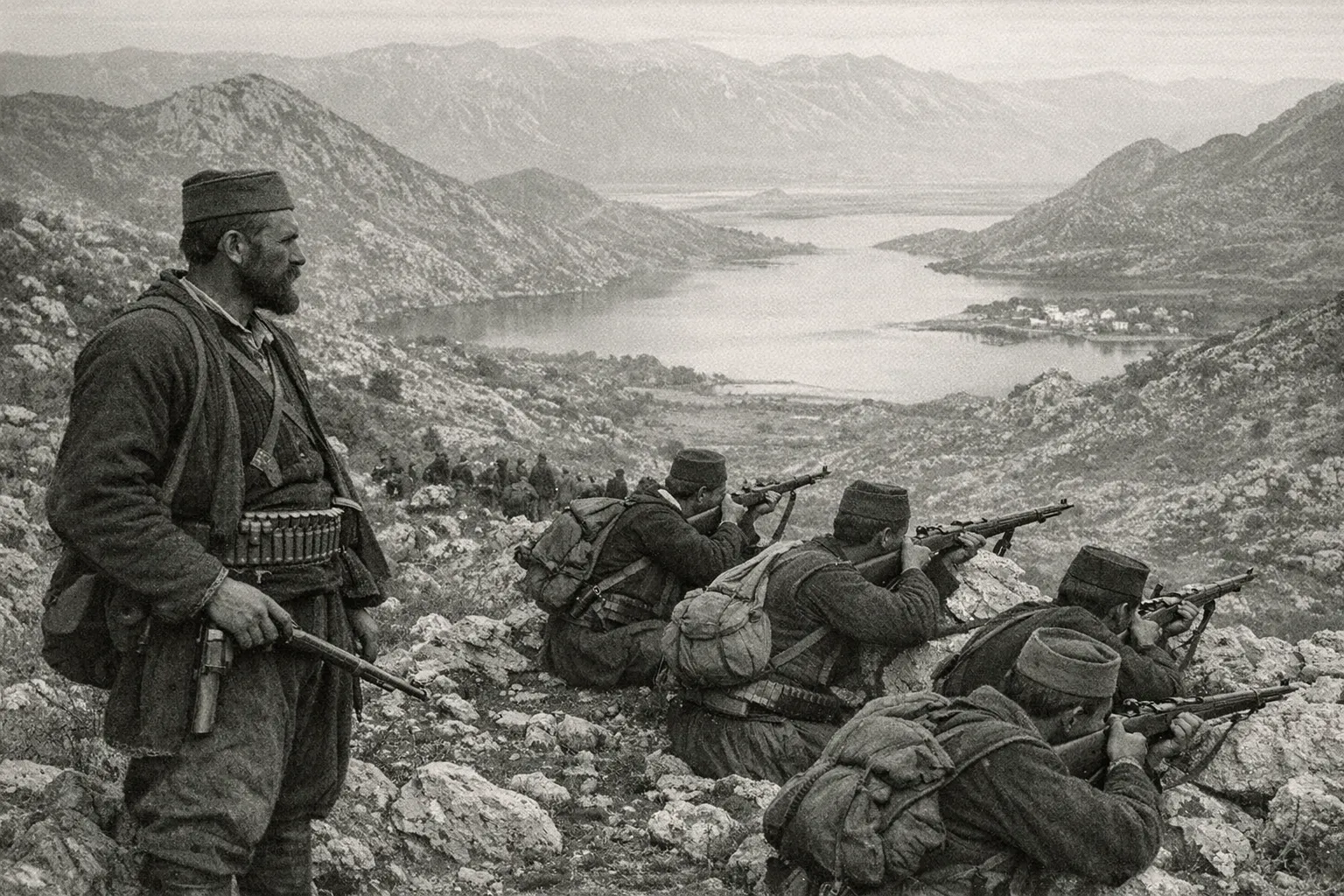
Contemporary reporting quickly described fighting along Montenegro’s frontier with Albania. A 1913 U.S. Naval Institute account traced the campaign across several fronts, from the approaches to Scutari (modern Shkodër) to Berane and Priepolje, then in the Sanjak of Novi Pazar. This account offers a view of how the war unfolded; later scholarship helps explain what Montenegro hoped to gain—and why its results fell short.
This introduction examines the declaration in that context: how Montenegro opened its campaign, how its territorial aims shaped its choices, and how its dependence on allies constrained them. It also distinguishes early battlefield gains from the settlement at the Treaty of London, which awarded Montenegro part of the Sanjak of Novi Pazar but not Scutari.
Opening scene: a declaration made under a warning
On October 8, 1912, Montenegro declared war on the Ottoman Empire, becoming the first Balkan League member to act in the First Balkan War. A 1913 account in the U.S. Naval Institute Proceedings places Montenegro’s declaration before the Ottoman Empire’s declarations against Bulgaria and Serbia on October 17 and Greece’s on October 18. A contemporary report in The Otago Witness, published October 16, likewise called Montenegro the first Balkan state to declare war and reported fighting along its frontier with Albania.
The diplomatic setting sharpened the risk. According to EBSCO Research Starters, Austria-Hungary and Russia issued a Great-Power warning against war and territorial changes on the same day. That warning was not part of Montenegro’s declaration; it was a separate signal that the crisis could draw in powers beyond the combatants.
Montenegro’s move was an opening gambit, not a move made on an empty board.
Its decision belonged to a wider contest between the Ottoman Empire and the Balkan states, whose participation followed on different dates. The question is whether moving first gave Montenegro a strategic advantage—or exposed how little a small state could achieve without reliable allies and leverage.
This article uses names found in contemporary reporting when describing events, adding modern names in parentheses where useful: Scutari (modern Shkodër), for example, and Berana (modern Berane).
What happened when: a compact chronology, with source labels
-
October 8, 1912 — Montenegro declares war on the Ottoman Empire. The 1913 U.S. Naval Institute Proceedings article “Notes on the Balkan War,” a near-contemporary military account, records Montenegro’s declaration before those of the other Balkan League states. Austria-Hungary and Russia issued a warning against war and territorial changes that same day, making the move a military opening and a diplomatic gamble.
-
October 9 — fighting near Mount Planinica. “Notes on the Balkan War” reports an engagement there as Montenegrin forces advanced. Its dates are useful contemporary evidence, but its spellings and military framing should not automatically be treated as modern consensus.
-
October 10 — Detchitch’s mountain fortifications taken. This is the source’s spelling for Dečić, near today’s Montenegro–Albania border.
-
October 13 — Priepolye taken. The account places it in the former Sanjak of Novi Pazar; the modern name is Prijepolje.
-
October 16 — newspaper report. The Otago Witness identified Montenegro as the first Balkan state to declare war and reported frontier fighting. This is early reporting, not a retrospective campaign history.
-
October 17 and 18 — the wider war expands. The Naval Institute account dates the Ottoman declaration against Bulgaria and Serbia to October 17, and Greece’s declaration to October 18. These are separate actions, not one simultaneous entry into the war. Later scholarship finds that Montenegro’s territorial aims were only partly achieved.
Why Montenegro moved first: goals, opportunity, and risk
Montenegro’s declaration of war on October 8, 1912, was not simply a response to the Great-Power warning issued that day. A retrospective study of Montenegrin policy identifies longstanding territorial ambitions in the Sandžak of Novi Pazar, Metohija, and Shkodër. The Sandžak lay between Montenegro and Serbia; Metohija is in what is now western Kosovo; and Shkodër—usually called Scutari in contemporary English-language reporting—is in present-day northern Albania, near Montenegro’s western frontier.
Contemporary reports show how those aims shaped the opening campaign. The U.S. Naval Institute Proceedings described three Montenegrin armies advancing on different routes, including a northern force tasked with taking Berana (modern Berane) and joining Serbian troops. It also recorded early fighting and gains at places including Priepolje, in the former Sanjak of Novi Pazar. These movements suggest an effort to pursue more than one objective, not a guarantee that Montenegro could secure them all.
That distinction matters. The same-day warning from Austria-Hungary and Russia opposed both war and territorial change, directly conflicting with Montenegro’s expansionist aims. This was a diplomatic gamble, but the record alone does not establish what King Nicholas I privately expected. Retrospective scholarship points to serious constraints: poor finances, limited equipment, and dependence on allies, especially Serbia. Montenegro later gained only part of its aims in the Sandžak and Metohija, while failing to retain Shkodër. The opening move created an opportunity—and exposed the limits of the state’s ability to exploit it.
The campaign’s opening map: three armies, several directions
A 1913 U.S. Naval Institute account describes Montenegro’s forces as divided into three armies, with forces operating north and south of Lake Scutari (modern Lake Skadar). The lake was more than a landmark: it helped organize the advance into separate directions, including the main effort toward Scutari (modern Shkodër).
The northern army had a different task. It was to capture Berana—modern Berane—and join Serbian forces. That objective shows why the campaign cannot be understood as a siege alone: Montenegro was also seeking to expand its position inland and coordinate with an ally.
A map can make this arrangement clearer. It should show the political geography of 1912–1913, including the Ottoman territories and borders then relevant to the campaign, rather than projecting present-day state boundaries backward. Use “Lake Scutari” for the historical narrative; “Lake Skadar” is useful as a modern orientation aid.
This plan offered a way to pursue territorial aims and coalition cooperation at once. It also created a trade-off: a limited force had to operate along separate routes and meet distinct objectives. The contemporary account establishes the army’s division and the northern task, but does not by itself tell us how troops were distributed among every objective. Retrospective scholarship places these movements within Montenegro’s broader aims in the Sandžak of Novi Pazar, Metohija, and Shkodër—ambitions that ultimately brought only partial gains.
Early advances: a brief case study in momentum
A 1913 account in the U.S. Naval Institute’s Proceedings reports a quick sequence of actions after Montenegro declared war on October 8. It places fighting near Mount Planinica on October 9, the capture of Detchitch’s mountain fortifications on October 10, and the taking of Priepolje on October 13. These are the account’s reported dates and place spellings, not a complete modern reconstruction of the fighting.
The sequence suggests why the opening could generate momentum beyond the principal advance toward Scutari (modern Shkodër). The same account describes a northern army tasked with taking Berane (then commonly rendered Berana) and linking up with Serbian forces. Priepolje—Prijepolje today—lay in the former Sanjak of Novi Pazar, so its reported capture belongs to the wider contest over routes and territory, not only operations around Lake Scutari.
These early actions show activity on more than one axis. They do not, on their own, establish that Montenegro could capture Scutari or secure all its territorial ambitions. Retrospective scholarship finds that Montenegro gained only part of its aims in the Sandžak and Metohija and did not retain Shkodër.
A compact map could plot the three reported sites and dates. Its caption should call it an orientation aid, distinguishing the Proceedings spellings from modern place names rather than implying precise battle locations.
Myth vs. reality: the declaration did not mean Scutari fell quickly
Myth: because Montenegro opened the First Balkan War, it quickly secured its principal western objective, Scutari. Reality: the declaration of war on October 8, 1912, began a campaign, not an immediate victory at the city.
A June 1913 account in the U.S. Naval Institute Proceedings says the siege of Scutari began in late October and continued into April. It reports that the city surrendered to Montenegro on April 23, 1913, but King Nicholas later agreed to evacuate it under Great-Power pressure; the last Montenegrin troops left on May 11. The surrender, then, was not an uncomplicated or lasting victory.
Scutari—the spelling used in many contemporary English-language reports, now Shkodër—stood in the Ottoman-era setting and the contested Albanian political context of the time. Today’s national borders should not be projected unchanged onto that conflict.
Retrospective scholarship helps explain the gap between Montenegro’s aims and results. It identifies Shkodër, alongside the Sandžak of Novi Pazar and Metohija, as a territorial objective, and links the limited gains to Montenegro’s financial weakness and dependence on allies. King Nicholas’s determination to pursue Shkodër also brought the kingdom into conflict with Great-Power policy.
That contrast is the significance of the October opening: military initiative could bring possession, but not durable control. Scutari’s fate depended on both the siege and international diplomacy.
What the army could sustain: resources and reliance on allies
A 1913 overview in the U.S. Naval Institute Proceedings put Montenegro’s wartime strength at 38,320. That figure is a contemporary estimate, not a definitive modern count. The writer described the army’s artillery as Krupp guns “not of a modern pattern.” This is the 1913 account’s assessment; it does not, by itself, establish how Montenegrin guns compared with every opposing force.
The 1913 account describes the force; later scholarship helps explain why its achievements remained limited. A study of Montenegro’s wartime objectives links those limits to the kingdom’s poor financial position and dependence on allies, especially Serbia. It also identifies King Nicholas I’s insistence on pursuing control of Scutari—modern Shkodër, then an Ottoman city—as a factor in the outcome. Montenegro gained only part of its intended territory in the Sandžak of Novi Pazar and Metohija, and did not secure Scutari.
The strategic implication is not that Montenegro lacked the capacity to fight: its mobilization was substantial. Rather, sustaining several territorial aims at once depended on scarce resources and on relationships with allies whose interests were not identical. The campaign’s opening could therefore demonstrate military initiative while leaving the kingdom vulnerable to the financial and diplomatic costs of a prolonged effort.
How the wider war changed the meaning of Montenegro’s first move
Montenegro’s declaration of war on October 8 made it the first Balkan League state to act. A contemporary U.S. Naval Institute account dates the Ottoman Empire’s declarations against Bulgaria and Serbia to October 17, and Greece’s to October 18; the International Encyclopedia of the First World War likewise places the allies’ entry later in October. These accounts distinguish Montenegro’s opening move from the coalition’s wider escalation.
The League was not a single command with identical aims. Montenegro sought territory in the Sandžak of Novi Pazar, Metohija, and Shkodër (then commonly called Scutari; modern Shkodër). Its northern army was tasked with taking Berane (then Berana) and linking up with Serbian forces, making coordination with Serbia a practical military concern as well as a diplomatic one. Retrospective scholarship notes that Montenegro gained only part of its aims in the Sandžak and Metohija, and did not secure Shkodër.
Greece’s campaign shows how quickly the war widened geographically. The Greek Presidency says victories at Sarantaporo and Giannitsa opened the route toward Thessaloniki (then Salonica), which Greek troops entered on October 27. That comparison places Montenegro’s campaign within a connected contest against Ottoman rule; it does not show that events in Greece caused Montenegro’s choices. For that, a source would need to make the link.
FAQ: names, dates, and what counts as a victory
Why is October 8 important? Montenegro declared war on the Ottoman Empire on October 8, 1912, the date commonly used to mark the First Balkan War’s opening. A 1913 U.S. Naval Institute account says Montenegro’s declaration preceded the Ottoman declarations against Bulgaria and Serbia on October 17 and Greece’s on October 18. The contemporary Otago Witness likewise called Montenegro the first Balkan state to declare war.
Was Montenegro the first Balkan League member to act? Yes. Both the contemporary report and the International Encyclopedia of the First World War overview identify Montenegro as the first member to enter the conflict. Its forces advanced on several fronts, including around Lake Scutari; a 1913 account reports early fighting near Mount Planinica and advances to Detchitch and Priepolye.
Did Montenegro capture Scutari? Yes, in April 1913. But capture was temporary: under Great-Power pressure, Montenegro evacuated the city. That military success did not become a lasting territorial settlement.
What do the place names mean? Scutari is the period English-language name for modern Shkodër; Berana is modern Berane; and Priepolye is modern Prijepolje. Retain a source’s period spelling when quoting or describing it, then give the modern name for orientation.
Was Montenegro’s territorial program successful? Only partly. Retrospective scholarship finds limited gains in Sandžak and Metohija, in areas shared with Serbia, but no Shkodër. The Treaty of London, signed May 30, 1913, awarded Montenegro part of the Sanjak of Novi Pazar but denied it Scutari. The scholarship also stresses Montenegro’s financial constraints and dependence on allies.
Pitfalls to avoid, then a concise verdict
- Do not call the declaration a guaranteed masterstroke. It gave Montenegro the initiative: a 1913 U.S. Naval Institute Proceedings account describes three armies advancing on separate axes, including a northern force tasked with taking Berana (modern Berane) and linking up with Serbian troops. But early movement did not remove Montenegro’s financial and military constraints or its dependence on allies.
- Do not flatten the sources’ perspectives. The Otago Witness report of October 16, 1912, and the 1913 Naval Institute articles are contemporary reporting. The later academic study of Montenegro’s territorial objectives and encyclopedia entries are retrospective analysis; use them to assess outcomes, not as eyewitness accounts.
- Do not treat place names as interchangeable. Establish the 1912–1913 names first: Scutari, Berana, and Priepolye in the former Sanjak of Novi Pazar. Give modern equivalents—Shkodër, Berane, and Prijepolje—for orientation.
- Do not equate battlefield gains with the territorial program. Separate early advances from the prolonged siege of Scutari, its evacuation under Great-Power pressure, and the Treaty of London’s settlement. Montenegro gained part of the Sanjak but not Scutari.
October 8 was consequential: Montenegro acted first and opened a multi-axis campaign. Yet the limited settlement shows that military momentum could not, by itself, secure the kingdom’s aims. Resources, reliance on Serbia, and Great-Power pressure narrowed the diplomatic result.
Opening scene: a declaration made under a warning
Montenegro declared war on the Ottoman Empire on October 8, 1912, becoming the first Balkan League member to act in the First Balkan War. A 1913 U.S. Naval Institute account dates Montenegro’s declaration to that day and records later declarations by Bulgaria, Serbia, and Greece; it did not mean every Balkan state entered the conflict at once. A contemporary Otago Witness report likewise identified Montenegro as the first Balkan state to declare war and reported fighting along its frontier with Albania.
The diplomatic setting sharpened the risk. According to EBSCO Research Starters, Austria-Hungary and Russia issued a Great-Power warning against war and territorial changes on the same day. That warning was not part of Montenegro’s declaration: it was the international response surrounding the decision. Montenegro acted amid efforts to restrain escalation, while the wider contest over Ottoman territory was drawing the Balkan states toward war.
The opening move was military as well as diplomatic. Contemporary reporting described Montenegrin forces advancing on several fronts, including around Lake Scutari. Retrospective scholarship places those operations within aims that included the Sandžak of Novi Pazar, Metohija, and Scutari. Did acting first give Montenegro strategic advantage, or expose the limits of a small state’s military and diplomatic leverage?
This article uses names found in contemporary sources for events, adding modern names where useful: Scutari (modern Shkodër) and Berana (modern Berane).
What happened when: a compact chronology, with source labels
- October 8, 1912 — Montenegro declares war on the Ottoman Empire. The 1913 U.S. Naval Institute Proceedings article “Notes on the Balkan War” dates Montenegro’s declaration before the other Balkan League states entered the conflict.
- October 9 — Fighting near Mount Planinica. “Notes on the Balkan War” reports action there as Montenegrin forces advanced on multiple fronts.
- October 10 — Detchitch’s mountain fortifications are taken. This is the contemporary account’s spelling; Detchitch refers to modern Dečić.
- October 13 — Priepolye is taken. The article places it in the former Sanjak of Novi Pazar. Its spelling “Priepolye” corresponds to modern Prijepolje.
- October 16 — A newspaper snapshot. The Otago Witness identified Montenegro as the first Balkan state to declare war and reported frontier fighting. This is early news coverage, not a retrospective campaign history.
- October 17–18 — Wider declarations follow. “Notes on the Balkan War” dates the Ottoman declaration against Bulgaria and Serbia to October 17, and Greece’s declaration to October 18. These were distinct actions, not one simultaneous opening.
The Naval Institute article is a near-contemporary military account: its dates are valuable evidence, but its spellings and military framing should not automatically be treated as modern consensus. The Otago Witness offers a separate contemporary perspective, shaped by reporting available at the time. Later scholarship is better suited to assessing Montenegro’s aims and the campaign’s eventual limits.
Why Montenegro moved first: goals, opportunity, and risk
Montenegro’s declaration of war October 8, 1912, was more than a response to the crisis around it. A retrospective study identifies three longstanding territorial ambitions: the Sandžak of Novi Pazar, between Montenegro and Serbia; Metohija, farther east; and Shkodër, called Scutari in many English-language accounts, near Montenegro’s western frontier. The declaration opened the First Balkan War, and contemporary reporting soon described fighting along Montenegro’s frontier with Albania (Otago Witness, October 16, 1912).
The opening campaign reflected those multiple aims. A 1913 U.S. Naval Institute account describes forces advancing on both sides of Lake Scutari and a northern army ordered to take Berane (then commonly rendered Berana) and link up with Serbian forces. It reported early actions at Detchitch and Priepolye, in the former Sanjak of Novi Pazar. These movements show strategic reach, not proof that Montenegro had the resources to secure every objective.
That distinction matters. The same-day warning from Austria-Hungary and Russia opposed both war and territorial change, putting the Great Powers’ position in direct tension with Montenegrin aims. It does not, by itself, establish what King Nicholas I privately expected. Retrospective scholarship instead stresses constraints: poor finances and dependence on allies, especially Serbia. Montenegro ultimately gained only part of its aims in the Sandžak and Metohija, and did not retain Shkodër (modern Shkodër, Albania).
The campaign’s opening map: three armies, several directions
A 1913 account in the U.S. Naval Institute’s Proceedings describes Montenegro’s forces as divided into three armies, with operations north and south of Lake Scutari. The lake was an organizing feature of the advance: it separated routes and fronts, while the campaign’s objectives extended beyond its shores.
The northern army was tasked with taking Berana—modern Berane—and joining Serbian forces. That assignment makes clear that Montenegro’s opening campaign was not confined to the siege of Scutari, now Shkodër. The same account reports early fighting near Mount Planinica, the capture of Detchitch’s fortifications, and the taking of Priepolje in the former Sanjak of Novi Pazar.
A map can make these directions easier to follow. It should show the political geography of 1912–1913, rather than project today’s borders backward. Use Lake Scutari for the campaign narrative; Lake Skadar is a modern name that can help orient readers where the map or source supports it.
The arrangement was a military opening and a diplomatic gamble. Several axes could pursue territorial aims and cooperation with Serbia at once. But a limited force also had to cover separate routes and objectives. The contemporary account establishes the armies’ broad roles, not an exact distribution of troops; the operational trade-off is clear without assuming more than the source says.
Early advances: a brief case study in momentum
A 1913 account in the U.S. Naval Institute’s Proceedings presents Montenegro’s opening as a campaign on more than one axis, not simply a rush toward Scutari (modern Shkodër). It reports fighting near Mount Planinica on October 9, the capture of Detchitch’s mountain fortifications on October 10, and the taking of Priepolje on October 13. These are the account’s reported dates and place-name spellings, rather than a complete modern reconstruction of the operations.
Priepolje—Prijepolje today—lay in the former Sanjak of Novi Pazar. Its reported capture matters because it points to the broader contest over routes and territory beyond the advance around Lake Scutari. Retrospective scholarship identifies the Sanjak, Metohija, and Shkodër among Montenegro’s territorial aims, while finding that its gains in the first two were partial and that it did not secure Shkodër.
The sequence suggests early activity across multiple directions and could foster momentum. It does not, on its own, show that Montenegro could take Scutari or achieve all its territorial aims. The prolonged siege and eventual loss of the city underline that distinction.
A compact map could plot Planinica, Detchitch (modern Dečić), and Priepolje/Prijepolje beside their reported dates. Label it an orientation aid, and distinguish the source’s period spellings from modern place names.
Myth vs. reality: the declaration did not mean Scutari fell quickly
The myth is that Montenegro’s declaration of war on October 8, 1912, quickly delivered its principal western objective. The contemporary U.S. Naval Institute account published in June 1913 gives a different timeline: the siege of Scutari began in late October and continued into April. Scutari, now Shkodër, was an Ottoman-era city in a region shaped by Albanian political claims; today’s borders should not be projected unchanged onto the conflict.
The same account says Scutari surrendered to Montenegro on April 23, 1913. But taking the city did not mean Montenegro could keep it. Under Great-Power pressure, King Nicholas agreed to evacuate, and the last Montenegrin troops left on May 11.
That reversal is the key to understanding the opening move. Montenegro acted first and brought military pressure to bear, but early initiative and temporary possession were not durable control. The city’s fate depended not only on the siege but also on international diplomacy.
Retrospective scholarship places the struggle within Montenegro’s broader territorial aims, including Shkodër, while emphasizing the kingdom’s limited resources and dependence on allies. The declaration therefore began a campaign, not a settled victory: Montenegro could take Scutari, but it could not hold it against the diplomatic settlement imposed by the Great Powers.
What the army could sustain: resources and reliance on allies
A 1913 overview in the U.S. Naval Institute’s Proceedings estimated Montenegro’s wartime strength at 38,320. That is a contemporary estimate, not a definitive modern count. The same writer described its artillery as Krupp guns “not of a modern pattern.” This is the period account’s assessment; it does not, by itself, establish how Montenegro’s equipment compared with every opposing force.
The 1913 account describes the force; later scholarship helps explain why its achievements remained limited. A study of Montenegro’s territorial objectives links the outcome to the kingdom’s poor financial position and dependence on allies, especially Serbia. It also identifies King Nicholas I’s insistence on pursuing control of Shkodër (then commonly rendered Scutari; modern Shkodër, Albania) as a factor in that limited success.
These constraints mattered because Montenegro’s ambitions extended beyond one front. Its objectives included territory in the Sandžak of Novi Pazar and Metohija, as well as Shkodër. The study finds that Montenegro gained only partial results in the first two areas, in lands also claimed by Serbia, and did not retain Shkodër.
The strategic implication is not that Montenegro lacked the capacity to campaign: it mobilized a substantial force and opened operations across several axes. Rather, its ability to sustain multiple territorial aims depended on limited finances and on relationships with allies whose interests did not always align with Nicholas’s priorities. Its opening move was therefore both a military commitment and a diplomatic gamble.
How the wider war changed the meaning of Montenegro’s first move
Montenegro’s declaration of war against the Ottoman Empire on October 8, 1912, made it the first Balkan League member to act. A 1913 Proceedings account dates the Ottoman declaration against Bulgaria and Serbia to October 17 and against Greece to October 18; the International Encyclopedia of the First World War likewise places the other League members’ entry later in October. Contemporary reporting in the Otago Witness identified Montenegro as the first state to declare war and reported fighting along its frontier with Albania.
That sequence did not mean the allies operated as one army with identical objectives. Montenegro’s northern forces were tasked with taking Berana (modern Berane) and joining Serbian forces, while its wider territorial aims included the Sandžak, Metohija, and Shkodër—then commonly called Scutari. Retrospective scholarship finds that Montenegro achieved only partial gains in the first two areas and did not secure Scutari.
Greek operations show how quickly the conflict widened geographically. The Greek Presidency’s account says victories at Sarantaporo and Giannitsa opened the route toward Thessaloniki—called Salonica in much contemporary English-language reporting—which Greek troops entered on October 27. This comparison puts Montenegro’s campaign in the context of a connected war against Ottoman rule; it does not establish that Greek victories caused Montenegro’s decisions. The campaigns had distinct aims and constraints, even as their outcomes shaped the wider contest.
FAQ: names, dates, and what counts as a victory
Why is October 8 important? Montenegro declared war on the Ottoman Empire on October 8, 1912, the date commonly used to mark the First Balkan War’s opening. A 1913 U.S. Naval Institute Proceedings account places Montenegro’s declaration before the Ottoman declarations against Bulgaria and Serbia on October 17 and Greece’s on October 18.
Was Montenegro the first Balkan League member to act? Yes. The International Encyclopedia of the First World War overview and an October 16 report in The Otago Witness identify Montenegro as the first. The newspaper described fighting along the frontier with Albania; the later military account records early actions at Mount Planinica, Detchitch, and Priepolye.
Did Montenegro capture Scutari? Yes, temporarily. Montenegrin forces took Scutari in April 1913, after a long siege, but withdrew under Great-Power pressure. Capture was a military success, not a lasting territorial settlement.
What do the place names mean? Scutari is the period English-language name for modern Shkodër, Albania; Berana is modern Berane, Montenegro; and Priepolye is modern Prijepolje, Serbia. Preserve a source’s spelling when discussing its wording, then give the modern name for orientation.
Did Montenegro achieve its territorial aims? Only partly. Retrospective scholarship describes partial gains in Sandžak and Metohija, in areas shared with Serbia, but no lasting control of Shkodër. The Treaty of London, signed May 30, 1913, awarded Montenegro part of the Sanjak of Novi Pazar but denied it Scutari.
Pitfalls to avoid, then a concise verdict
-
Do not call the declaration a guaranteed masterstroke. Montenegro acted first and opened a multi-axis campaign, but initiative was not the same as assured success. A 1913 U.S. Naval Institute account describes three armies operating around Lake Scutari and reports early advances at Detchitch and Priepolye. Those gains show reach, not that Montenegro could sustain the campaign or secure every objective.
-
Do not flatten the sources into one retrospective account. The Otago Witness report of October 16, 1912, and the 1913 Naval Institute Proceedings articles are contemporary reporting. The later academic study of Montenegro’s territorial objectives and encyclopedia entries are retrospective analysis; use them to assess outcomes, not as eyewitness accounts.
-
Do not leave place names unexplained. Establish the 1912–1913 names first: Scutari, Berana, and Priepolye. Then give modern equivalents for orientation—Shkodër, Berane, and Prijepolje—without implying that historical borders or political contexts were identical.
-
Do not equate battlefield gains with the territorial program. Distinguish early advances from the siege of Scutari, its surrender and subsequent evacuation under Great-Power pressure, and the settlement in the Treaty of London. The later study finds only partial gains in Sandžak and Metohija, shared with Serbia, and no lasting acquisition of Scutari.
The Montenegro declaration of war October 8 1912 mattered because it seized the initiative and opened a campaign on several axes. Its limited territorial results, however, reveal how scarce resources, reliance on allies, and Great-Power pressure constrained Montenegro’s aims.