
Marie Curie's journey through the world of science is a compelling narrative of brilliance and resilience. As the first woman to earn a Nobel Prize, her legacy is not just defined by her groundbreaking discoveries but also by the societal obstacles she faced in a predominantly male field.
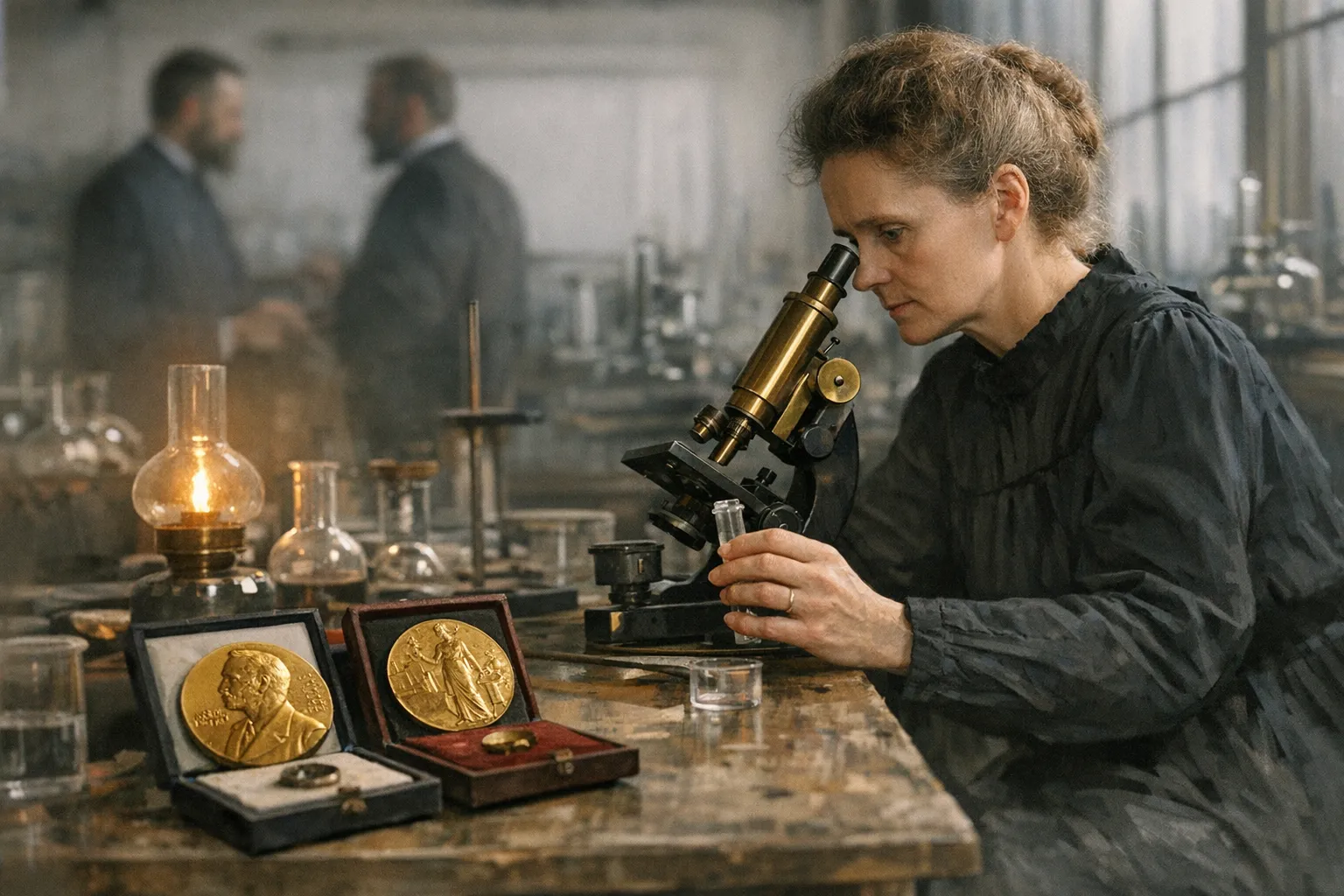
In this exploration, we will delve into Curie's monumental contributions to science, including her pioneering work on radioactivity and the discovery of polonium and radium. We will also examine the significant challenges she encountered, from gender-based discrimination to her role as a trailblazer for women in academia. By understanding the duality of her triumphs and struggles, we can appreciate the profound impact Curie had on both science and the fight for gender equality.
Introduction: The Legacy of Marie Curie
Marie Curie stands as a monumental figure in the landscape of science, not only for her groundbreaking discoveries but also as a symbol of perseverance in a male-dominated field. Born in Poland in 1867, Curie's relentless pursuit of knowledge led her to Paris, where her revolutionary work on radioactivity earned her the distinction of being the first woman to receive a Nobel Prize in 1903. This award was shared with her husband Pierre Curie and Henri Becquerel, recognizing their collective research on radioactive phenomena.
Curie's significance is further underscored by her second Nobel Prize in Chemistry in 1911, awarded for her isolation of the elements polonium and radium. This achievement not only showcased her scientific prowess but also solidified her position in history as the only individual to win Nobel Prizes in two different scientific fields.
However, Curie's journey was not without its challenges. Despite her towering achievements, she faced considerable gender-based discrimination. For instance, she was excluded from the French Academy of Sciences, an institution that remained largely inaccessible to women at the time. Yet, Curie's determination shattered barriers; she became the first female professor at the University of Paris and founded the Radium Institute, which became a leading center for nuclear physics and chemistry research.
As she once said, "Life is not easy for any of us, but what of that? We must have perseverance and above all confidence in ourselves." Her legacy continues to inspire generations of women in science, reinforcing the idea that determination can conquer societal norms and pave the way for future breakthroughs.
The First Nobel Prize: A Breakthrough in Physics
Marie Curie's first Nobel Prize in Physics, awarded in 1903, marked a monumental achievement not only for her but also for women in science. Her pioneering research on radioactivity introduced the term itself and led to the discovery of two new elements: polonium and radium. This groundbreaking work fundamentally altered the scientific landscape and opened up new avenues for research in both physics and medicine.
Curie's impact on the scientific community was profound. She became a beacon of hope for women aspiring to enter fields dominated by men. As the first woman to win a Nobel Prize, her achievement shattered glass ceilings, proving that dedication and intellect could transcend societal barriers.
“Curie's journey through science was like a beam of light cutting through the darkness of ignorance.”
Despite her remarkable contributions, Curie faced significant challenges, including gender-based discrimination. For instance, she was notably excluded from the French Academy of Sciences, a clear indication of the prejudice women encountered at the time. Nevertheless, her resilience shone through as she became the first female professor at the Sorbonne University, thereby setting a precedent for future generations of women in academia.
Curie's legacy is not only encapsulated in her Nobel Prizes but also in her unwavering commitment to mentoring and empowering women in science. By founding the Radium Institute in Paris, she created a leading center for nuclear physics and chemistry research, further solidifying her role as a trailblazer in a male-dominated field. Her work continues to inspire and empower, serving as a powerful reminder of the potential that lies within all individuals, regardless of gender.
The Second Nobel Prize: Chemistry and New Discoveries
Marie Curie's second Nobel Prize, awarded in 1911 for her groundbreaking work in Chemistry, marked a significant milestone not only in her career but also in the broader scientific community. Her discoveries of the elements polonium and radium were pivotal in advancing the field of chemistry and laid the groundwork for future research into radioactivity.
-
Discovery of Polonium and Radium: Curie's identification of these two elements was revolutionary. Polonium, named after her native Poland, and radium, with its intense radioactivity, provided new avenues for scientific exploration. These discoveries were instrumental in understanding atomic structure and radiation.
-
Introduction of the Term 'Radioactivity': Curie was the first to coin the term 'radioactivity,' describing the phenomena of spontaneous emission of particles from unstable atomic nuclei. This concept not only shaped her research but also influenced a generation of scientists who delved into the complexities of atomic physics.
-
Significance of Her Contributions to Chemistry: Curie's work transcended pure chemistry; it contributed significantly to various fields, including medicine. Her research laid the foundation for the use of radiation in cancer treatment, showcasing the potential of her discoveries to save lives. Furthermore, her establishment of the Radium Institute in Paris created a leading center for nuclear physics and chemistry, fostering future innovations.
Despite facing considerable gender-based discrimination, such as being excluded from the French Academy of Sciences, Curie's achievements in chemistry and her role as the first female professor at the Sorbonne University broke significant barriers for women in science. Her relentless pursuit of knowledge and mentorship of aspiring female scientists have left a lasting legacy, inspiring new generations to challenge societal norms and pursue careers in STEM fields.
Challenges Faced: Gender Discrimination in Science
Marie Curie's journey in the male-dominated field of science was marked not only by her groundbreaking achievements but also by significant challenges stemming from gender discrimination. Despite her monumental contributions, she faced obstacles that would deter many.
-
Exclusion from the French Academy of Sciences: Despite her groundbreaking work, Curie was famously excluded from this prestigious institution. Her exclusion highlighted the pervasive gender biases that existed, even against someone with her credentials.
-
Struggles for Recognition: Curie's pioneering research on radioactivity, for which she received her first Nobel Prize in Physics in 1903, was often overshadowed by her male counterparts. Even after winning a second Nobel Prize in Chemistry in 1911 for discovering polonium and radium, she had to fight for the recognition that her male peers received more readily.
-
Personal Sacrifices and Societal Pressures: Curie's relentless pursuit of knowledge came at a personal cost. Balancing her scientific ambitions with societal expectations of women during the early 20th century was a significant challenge. She often faced scrutiny for prioritizing her career over traditional female roles, navigating a landscape that was not only competitive but also hostile to women.
Despite these hurdles, Curie's legacy is a testament to resilience. She became the first female professor at the University of Paris and established the Radium Institute, inspiring generations of women to challenge societal norms and pursue careers in science. Her story is not just one of triumph but also a poignant reminder of the barriers women have historically faced in academic and scientific spaces.
Breaking Barriers: Curie's Role in Academia
Marie Curie’s influence in the academic world is perhaps best exemplified by her role as the first female professor at the University of Paris. This milestone was not just a personal achievement; it represented a significant shift in a male-dominated field, paving the way for women in science.
Curie's appointment to the Sorbonne in 1906 was groundbreaking. She became the first woman to lecture there, challenging societal norms and encouraging women to pursue higher education in science. Her presence in academia inspired many, proving that women could excel in scientific fields traditionally reserved for men.
-
Impact on Women in Academia: Curie’s achievements opened doors for women in various scientific disciplines. Her legacy is evident in the increasing number of female scientists who followed her footsteps, breaking barriers and claiming their rightful place in academia.
-
Mentorship of Female Scientists: Curie didn’t just excel personally; she actively mentored other women in science. Many female scientists worked in her laboratory, benefiting from her guidance and support. This network not only fostered collaboration but also created a community of women who could share knowledge and encouragement.
Curie's relentless pursuit of knowledge and her groundbreaking discoveries continue to inspire generations of women, reinforcing the idea that determination and intellect know no gender. Her legacy is a testament to the power of overcoming societal challenges in the quest for scientific advancement.
Innovations During War: The 'Little Curies'
During World War I, Marie Curie's contributions extended far beyond her groundbreaking research in radioactivity. Her innovative spirit manifested in the creation of mobile X-ray units, affectionately dubbed the 'Little Curies.' These units were pivotal in assisting battlefield surgeons by providing vital imaging capabilities to locate bullets and shrapnel in wounded soldiers.
-
Mobile X-ray Units: Curie's 'Little Curies' were portable X-ray machines that could be deployed close to the front lines. This technology was revolutionary, making it possible to perform quick assessments of injuries that would otherwise have gone undetected until surgery.
-
Assistance to Battlefield Surgeons: The ability to visualize internal injuries significantly improved surgical outcomes. Surgeons could make informed decisions during operations, ultimately saving countless lives. Curie's work ensured that medical personnel had the tools necessary to treat injuries more effectively in the chaos of war.
-
Legacy of Her Wartime Innovations: Curie's wartime innovations not only showcased her technical genius but also demonstrated her commitment to humanitarian efforts. The impact of the 'Little Curies' extended beyond the war, laying the groundwork for future medical imaging techniques. Her determination to apply science for the betterment of society solidified her legacy as a pioneer in both science and medicine.
Curie's efforts during the war illustrate the duality of her life; she navigated the constraints of a male-dominated field while profoundly impacting the lives of many. Her work continues to inspire generations, highlighting the essential role of women in science. For further insights into her achievements, you can explore Marie Curie's Nobel Prize Achievements and Women in Science: The Legacy of Marie Curie.
The Radium Institute: A Center for Research
In 1914, Marie Curie established the Radium Institute in Paris, a pivotal moment in the history of science. This institution quickly became a leading center for research in nuclear physics and chemistry, underlining Curie’s commitment to advancing scientific knowledge despite the societal challenges she faced as a woman in a male-dominated field.
The Radium Institute was not merely a research facility; it was a beacon of innovation that attracted scientists from around the globe. Curie’s vision for the institute was to create an environment where both men and women could collaborate and explore the mysteries of radioactivity. The institute's influence can be seen in several key areas:
-
Advancement in Nuclear Research: The Radium Institute played a crucial role in expanding our understanding of radioactivity, paving the way for future breakthroughs in nuclear physics.
-
Empowerment of Women: Curie’s laboratory became a nurturing ground for female scientists, who were often marginalized in academic circles. Many women trained under her guidance, fostering a new generation of researchers.
-
Foundation for Medical Applications: Research conducted at the institute laid the groundwork for the medical use of radiation, particularly in cancer treatment. This legacy continues to impact healthcare today.
Curie's relentless pursuit of knowledge and her pioneering spirit established the Radium Institute as a cornerstone for research, challenging not only scientific boundaries but also societal norms regarding women's roles in science. Her achievements at the institute exemplify her enduring influence, inspiring countless women to break into fields previously dominated by men.
Curie's Enduring Influence on Women in Science
Marie Curie's legacy extends far beyond her scientific achievements; she serves as a powerful symbol for women in science, inspiring future generations to break barriers in a historically male-dominated field. Her role as a mentor and advocate for aspiring female scientists is particularly noteworthy. Curie's laboratory was a hub for women researchers, many of whom she guided and supported, fostering a collaborative environment that encouraged their growth.
Curie's groundbreaking work, including her discoveries of polonium and radium, not only advanced the field of radioactivity but also laid the groundwork for significant medical advancements, particularly in cancer treatment. The relevance of her discoveries continues to resonate today, as scientists build on her foundational research to innovate in nuclear physics and medicine.
Moreover, Curie's status as the first woman to receive a Nobel Prize in Physics in 1903, and later in Chemistry in 1911, serves as a beacon of hope and motivation. Her achievements challenge societal norms and show that women can excel in scientific endeavors.
Curie's efforts to establish the Radium Institute in Paris underscored her commitment to advancing women in science and ensuring that future generations had access to education and research opportunities. As the first woman to lecture at the Sorbonne, she broke significant gender barriers, demonstrating that women could thrive in academia despite facing adversity.
In sum, Marie Curie’s enduring influence is felt in the continued push for gender equality in science, inspiring countless women to pursue their dreams and make their own mark on the world.
Myths vs. Reality: Debunking Misconceptions about Curie
Marie Curie's life and work are often shrouded in myths that misrepresent her reality. Understanding these misconceptions can illuminate her true legacy and the challenges she faced.
-
Myth: Curie's scientific achievements were overshadowed by her husband.
While Pierre Curie played a significant role in her early research, Marie was the driving force behind their discoveries. She won the Nobel Prize in Physics in 1903 for her independent work on radioactivity and later received a second Nobel in Chemistry in 1911 for discovering polonium and radium. -
Myth: Curie worked in isolation.
Contrary to this belief, Curie fostered a network of female scientists, mentoring many who worked in her laboratory. This support system was crucial in an era when women were largely excluded from scientific fields. -
Reality: Curie's gender posed significant challenges.
Despite being a pioneer, Curie faced considerable gender-based discrimination. She was notably excluded from the French Academy of Sciences, highlighting the barriers women encountered in academia. However, she persevered, becoming the first female professor at the University of Paris. -
Reality: Curie's contributions extend beyond her Nobel Prizes.
Her innovative work during World War I, including the development of mobile X-ray units known as 'Little Curies,' showcased her practical application of science to save lives. Additionally, her research laid the groundwork for using radiation in medical treatments.
Understanding these aspects of Marie Curie's life helps clarify her profound impact on science and society. Her relentless pursuit of knowledge and groundbreaking discoveries continue to inspire generations of women to challenge societal norms and pursue careers in science.
Conclusion: The Lasting Impact of Marie Curie
Marie Curie's legacy is characterized by her groundbreaking achievements and the formidable challenges she faced as a woman in science. As the first woman to receive a Nobel Prize, awarded in Physics in 1903 for her pioneering research on radioactivity, she shattered glass ceilings in a male-dominated field. Her subsequent Nobel Prize in Chemistry in 1911 for discovering polonium and radium solidified her status as a scientific pioneer.
Curie's contributions extend beyond her dual Nobel Prizes. She founded the Radium Institute in Paris, which became a leading center for nuclear research, and her relentless pursuit of knowledge laid the groundwork for advancements in medical radiation, particularly in cancer treatment. Additionally, her development of mobile X-ray units during World War I exemplified her commitment to applying science for humanitarian purposes.
However, Curie's path was fraught with obstacles, including gender-based discrimination and exclusion from prestigious institutions like the French Academy of Sciences. Yet she persevered, becoming the first female professor at the Sorbonne University, thereby paving the way for future generations of women in academia.
Her legacy calls for continued support of women in science. As we reflect on Curie's accomplishments, let us champion initiatives that empower aspiring female scientists. By doing so, we honor her memory while fostering a more inclusive scientific community. For more on her achievements, check out Marie Curie's Nobel Prize Achievements and explore the impact she had on her contemporaries in Women in Science: The Legacy of Marie Curie.